10 questions. Tap an answer to see if you are right, and why. Nothing is saved.
0 of 10 answered, 0 correct
Question 1 of 10
The rate equation for a reaction is rate = k[P][Q]². What happens to the rate when [P] is doubled and [Q] is halved at the same time?
Question 2 of 10
The rate equation for a reaction is rate = k[A]²[B]. Rate is measured in mol dm⁻³ s⁻¹. What are the units of the rate constant, k?
Question 3 of 10
In initial-rate experiments, doubling [X] makes the rate 4 times faster, and doubling [Y] leaves the rate unchanged. What is the rate equation?
Question 4 of 10
For the reaction NO₂ + CO → NO + CO₂, the rate equation is rate = k[NO₂]². Which step could be the rate-determining step?
Question 5 of 10
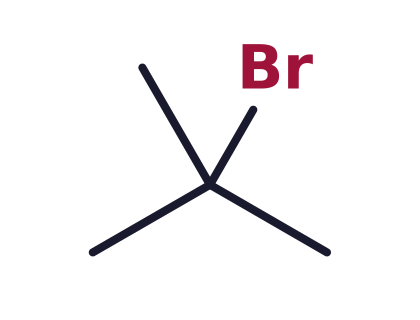
2-bromo-2-methylpropane (shown) is hydrolysed by aqueous hydroxide ions. The rate equation is rate = k[(CH₃)₃CBr]. What does this show?
Question 6 of 10
A, B and C all appear in the equation for a reaction. The rate equation is rate = k[A]²[C]. What is the overall order, and the order with respect to B?
Question 7 of 10
How is the initial rate of a reaction found from a graph of concentration against time?
Question 8 of 10
The Arrhenius equation can be written as ln k = −Ea/RT + ln A. Which graph gives a straight line with a gradient of −Ea/R?
Question 9 of 10
A graph of ln k against 1/T has a gradient of −1.20 × 10⁴ K. What is the activation energy? (R = 8.31 J K⁻¹ mol⁻¹)
Question 10 of 10
The temperature of a reaction mixture is raised from 300 K to 310 K. Which statement about the rate constant, k, is correct?