AQA · A Level Chemistry · 7405
Learn A Level Chemistry with an AQA-specific tutor.
Dexter teaches any topic step by step and sets AQA-style questions for you to practise. Every question you do builds your profile and your topic readiness for each exam paper.

- 3 papersPaper 1, Paper 2 and Paper 3, 2 hours each
- 300 marks105 + 105 + 90, all sat at the end of Year 13
- 34 topicsFrom 3.1.1 Atomic structure to 3.3.16 Chromatography
- 24/7Ask Dexter whenever you're working
A real reply from Dexter
The explanation, then what the mark scheme wants.
Ask Dexter anything on the AQA course, the way you'd ask it. He explains it step by step, then shows you which points gain the marks.
 Dexter
Why does 1st ionisation energy drop from magnesium to aluminium?

Good question — and this is one of the two exceptions AQA love to test.
Magnesium ends in 3s², aluminium starts in 3p¹. The 3p electron in aluminium is in a higher energy subshell than the 3s electrons in magnesium — it's slightly further from the nucleus and is partially shielded by the 3s electrons beneath it. So despite aluminium having one more proton, its outer electron is easier to remove.
The mark scheme wants three things:
- Al has its outer electron in a 3p subshell, Mg has its outer electron in a 3s subshell
- The 3p electron is at higher energy / further from the nucleus
- The 3p electron is shielded by the 3s electrons (or: the 3s subshell shields the 3p)
Put those three together and you've got full marks every time.
How AQA examines you
Your three AQA papers.
AQA A Level Chemistry is 3 papers and 300 marks, all sat at the end of Year 13. Pick a paper to see what it covers.
Paper 1
- 2 hours
- 105 marks
- 35% of the A Level
Inorganic chemistry, with the physical chemistry topics listed here and the practical skills that go with them.
- 105 marks of short and long answer questions
Physical
- 3.1.1 Atomic structure
- 3.1.2 Amount of substance
- 3.1.3 Bonding
- 3.1.4 Energetics
- 3.1.6 Chemical equilibria
- 3.1.7 Oxidation and reduction
- 3.1.8 Thermodynamics
- 3.1.10 Equilibrium constant Kp
- 3.1.11 Electrode potentials and cells
- 3.1.12 Acids and bases
Inorganic
- 3.2.1 Periodicity
- 3.2.2 Group 2
- 3.2.3 Group 7
- 3.2.4 Properties of Period 3 elements and their oxides
- 3.2.5 Transition metals
- 3.2.6 Reactions of ions in aqueous solution
Paper 2
- 2 hours
- 105 marks
- 35% of the A Level
Organic chemistry, with the physical chemistry topics listed here and the practical skills that go with them.
- 105 marks of short and long answer questions
Physical
- 3.1.2 Amount of substance
- 3.1.3 Bonding
- 3.1.4 Energetics
- 3.1.5 Kinetics
- 3.1.6 Chemical equilibria
- 3.1.9 Rate equations
Organic
- 3.3.1 Introduction to organic chemistry
- 3.3.2 Alkanes
- 3.3.3 Halogenoalkanes
- 3.3.4 Alkenes
- 3.3.5 Alcohols
- 3.3.6 Organic analysis
- 3.3.7 Optical isomerism
- 3.3.8 Aldehydes and ketones
- 3.3.9 Carboxylic acids and derivatives
- 3.3.10 Aromatic chemistry
- 3.3.11 Amines
- 3.3.12 Polymers
- 3.3.13 Amino acids, proteins and DNA
- 3.3.14 Organic synthesis
- 3.3.15 NMR spectroscopy
- 3.3.16 Chromatography
Paper 3
- 2 hours
- 90 marks
- 30% of the A Level
Any topic from the whole specification, and any practical skills.
- 40 marks on practical techniques and data analysis
- 20 marks testing across the specification
- 30 marks of multiple choice questions
What you get
Everything Dexter does, made for AQA.
Exam questions, written for you
Fresh exam-style questions on any topic, in the style of your exam board and marked instantly.
Tests, built for you
Choose your topics and Dexter writes you a test, then marks it against the marking points.
Past papers, marked
Input your past paper results and see how you did on every sub-topic.
Flashcards
Quick-fire cards on any topic, made for your course, to lock in the key facts and definitions.
Diagrams that move
Mechanisms, curves and structures build step by step as Dexter explains them.
Weekly coaching sessions
Big topics, exam technique and revision strategy with Rich every week. Submit a question any time.
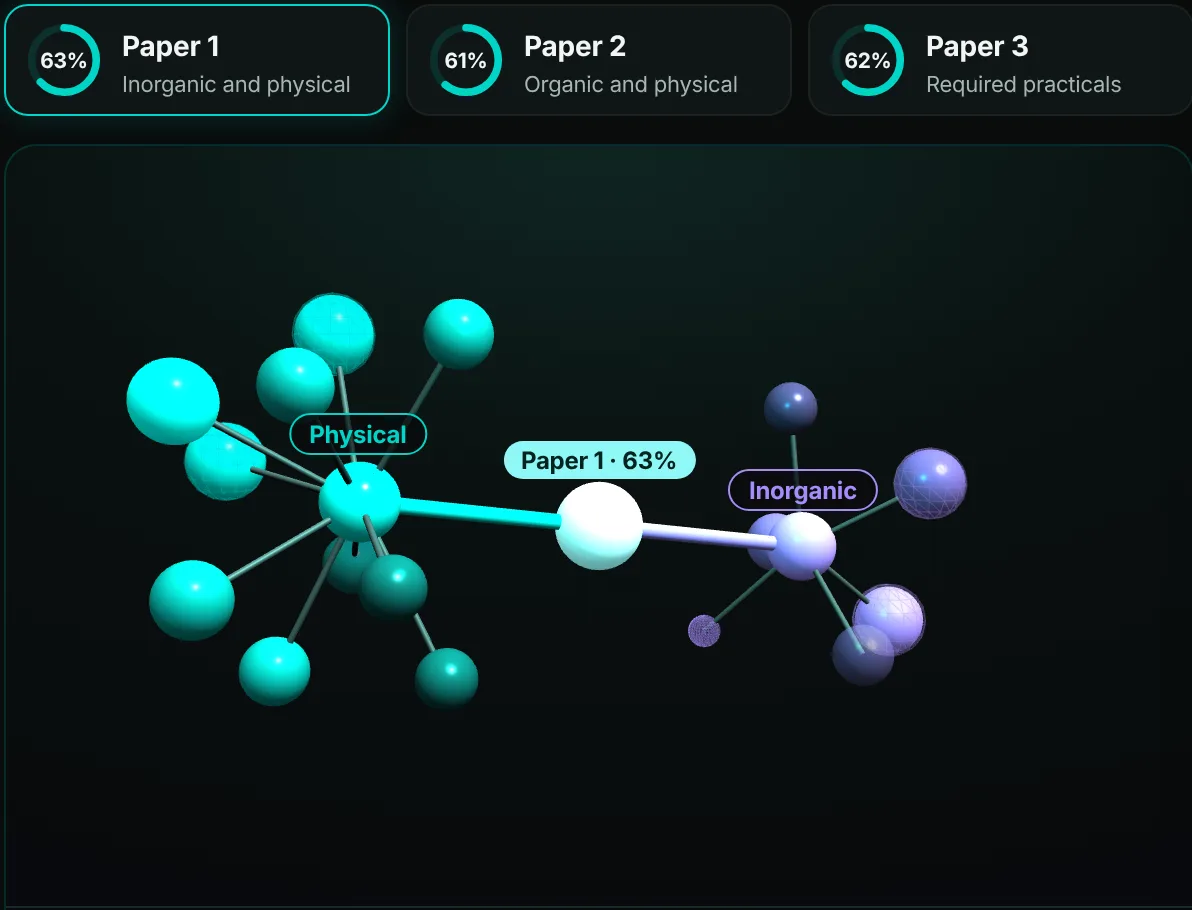
Paper by paper
See how ready you are for each paper.
Each paper is a molecule and each topic is an atom that grows as you get questions right. Your scores come from your own answers, so you know what to work on next.

Built by a real teacher, not a tech company.
Rich Warburton is a practising Head of Chemistry with 21 years teaching A Level Chemistry. He built Chemistry Coach, trained Dexter, and runs the weekly coaching sessions.
About RichHow the trial works
14 days to see how Dexter teaches AQA.
- Create your accountSign up with AQA as your exam board. No card is needed to start the trial.
- Work with Dexter for 14 daysFull access to all resources and up to 120 messages with Dexter, so you can see how he teaches.
- Join when you're readyFull Membership is £49 a month. If you don't join, nothing is charged and your profile stays.
Free AQA tools
Try Rich's interactive tools, made for AQA.
14 of Rich's interactive tools have a AQA version, matched to your specification. Here are 4 to start with. No login needed.
Ionisation energies
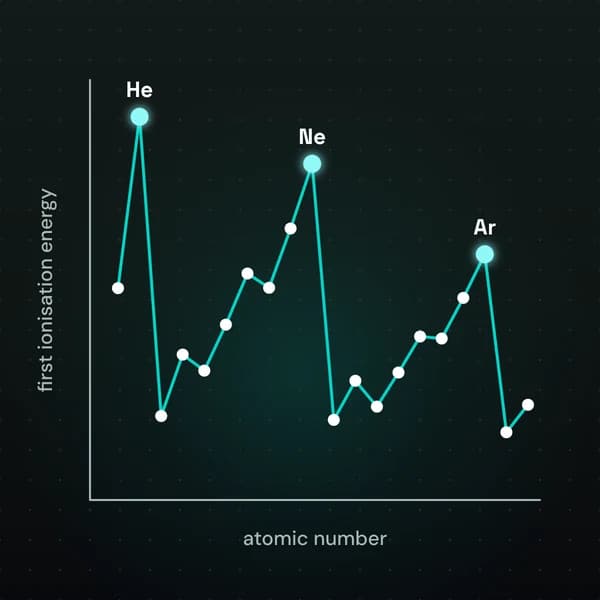
Graphs first ionisation energies across periods and down groups, and successive ionisation energies electron by electron. Practise and test yourself.
Open for AQA: Ionisation energies (opens in a new tab)Le Chatelier's principle
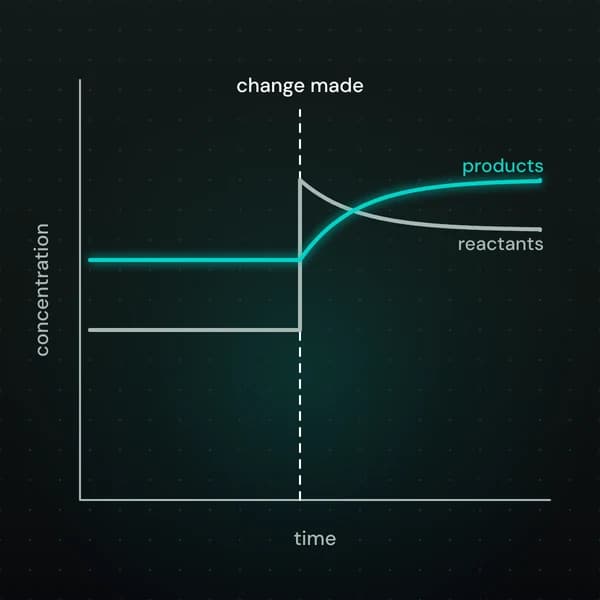
Change a concentration, the temperature or the pressure, or add a catalyst, and watch the equilibrium position shift on a live concentration-time graph.
Open for AQA: Le Chatelier's principle (opens in a new tab)Organic mechanisms
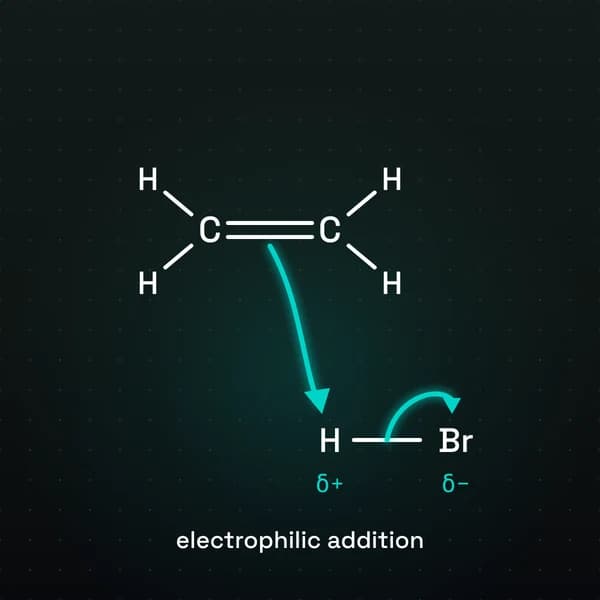
Steps through each organic mechanism with curly arrows, from electrophilic addition to electrophilic substitution of benzene, then practise and test yourself.
Open for AQA: Organic mechanisms (opens in a new tab)Transition metal complexes
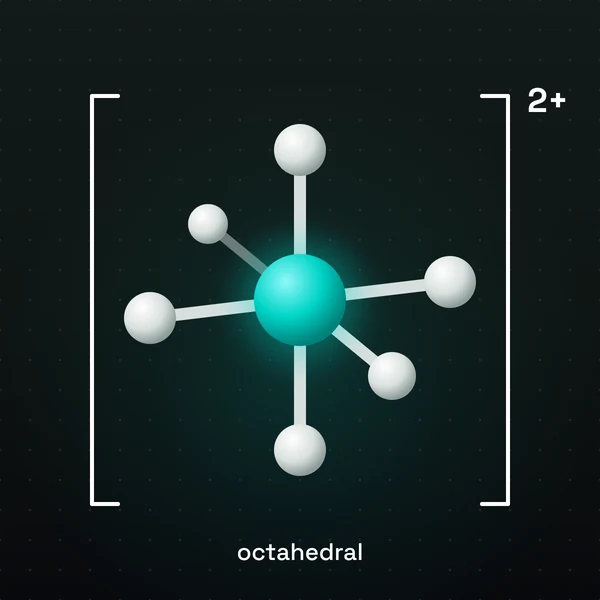
Rotate 3D models of complex ions, and add reagents to aqua ions to see the precipitates, ligand substitution, colour changes and equations.
Open for AQA: Transition metal complexes (opens in a new tab)
FAQs
Questions, answered.
Is Dexter matched to the AQA A Level Chemistry specification?
Yes. Dexter follows AQA specification 7405 topic by topic, from 3.1.1 Atomic structure to 3.3.16 Chromatography, and keeps to what the course asks for.
How is AQA A Level Chemistry assessed?
By 3 written papers at the end of Year 13. Paper 1 and Paper 2 are 2 hours and 105 marks each, and each is worth 35% of the A Level. Paper 3 is 2 hours and 90 marks, worth 30%.
What is on each AQA A Level Chemistry paper?
Paper 1 covers inorganic chemistry and the physical chemistry that goes with it. Paper 2 covers organic chemistry and the physical chemistry that goes with it. Paper 3 can ask about any topic: 40 marks on practical techniques and data analysis, 20 marks testing across the specification, 30 marks of multiple choice questions.
What do I need to get an A* in AQA A Level Chemistry?
AQA sets new grade boundaries every year, so there is no fixed mark. In June 2026 the A* boundary was 255 out of 300. Across the 8 June exam series from 2017 to 2026 it averaged 244 out of 300. Your grade comes from your three papers added together.
Does Dexter help with Year 12 and AS Chemistry?
Yes. In Year 12 Dexter keeps to the first-year topics, which are the AS content, and doesn't set second-year questions.
Can Dexter write AQA-style exam questions?
Yes. Dexter writes fresh exam-style questions on any topic, in the style of AQA's papers, and marks your answers straight away.
Can I use my AQA past paper results?
Yes. Input your past paper results and see how you did on every sub-topic.
How is Dexter different from a general AI chatbot?
General AI tools often teach more than the course needs and aren't matched to a specification. Dexter has one job: A Level Chemistry, as your specification sets it out.
How much does it cost?
£49 a month, after a 14-day trial with up to 120 messages with Dexter. No card is needed to start the trial, and you can cancel any time, with no lock-in.
What happens when the trial ends?
Nothing is charged, because we never took a card. Your profile stays, and you can join whenever you're ready.
Ask Dexter about the AQA
topic you're stuck on.
Free for 14 days, no card required.